
Father issues are at base of it all, on top of which is my frustration at failing to attain even a modicum of the recognition and success that some of the filmmakers I enjoyed demolishing had attained. And of course, the very drive to attain such success (getting world’s attention) was itself sourced in those father issues.
But all that is rather rudimentary, and a bit simplistic. It’s true that if I had succeeded as a scriptwriter/filmmaker in Hollywood, I wouldn't ever have written The Blood Poets. But on the other hand, I began writing film criticism before, or simultaneous with, writing film scripts (at about 14). In fact, some of the first “reviews” I wrote were imaginary ones of the films I would some day make (I recall one called Houses in Motion, starring Robert De Niro and Jessica Lange, the title taken from the Talking Heads song). . . . So the two drives co-existed from the start, which indicates that it wasn't frustration that led me to write the film books, but merely a natural alternative mode of expression that pertained to the same area, that of movies.
What actually inspired Blood Poets was re-reading Pauline Kael for the umpteenth time and thinking, “I wish I could do that.” The penny then dropped: "Hey, I could!" By that time (late 20s), I was less into movies, watching or making them, than I was into reading about them, and as already stated, I had more passion for Kael and her writings than I did for most, if not all, filmmakers. She was closer to a kindred spirit, let's say, than any filmmaker, presumably (in part) because I was more of a writer than a visual artist.
One of the things that most impressed me about Kael was how she could influence my own feelings about a movie. Films I liked I would grow cool towards after reading her totally demolishing them; films she admired I would give a second look. (Ironically, she was less persuasive in this direction, and rarely did one of her reviews change my mind about a movie I didn’t care for, while it was frequent occurrence for the reverse to happen.) Kael saw through the contrivances and conceits of filmmakers, and the gullibility of audiences, and exposed the hypocrisy and dishonesty at their core. Her influence was especially profound on me because I discovered her while I was still a teenager, so with movies that I would have grown out of/seen through eventually, she accelerated that process. (A good example would be Midnight Express, a film I loved at 14, so that I must have been disappointed by her trashing it at the time. Yet by the time I wrote about the film for Blood Poets, I found myself trashing it also, albeit in my own voice ~ because she had been right, it did suck as a movie!)
Yet underneath all this, my desire to write film criticism, and specifically to demolish films that were highly regarded and bring the filmmakers down to size, really pertained to a need to validate my reality.
It was pointed out to me recently that, since the filmmakers I criticized rarely read my criticism, it wasn't having any effect on the quality of filmmaking per se. This is probably accurate, and now that I think about it, the target of my vitriol was always less the filmmaker than the audience , who, by buying into such crap, were endorsing it and keeping the crapola machine running. If a talented filmmaker made a poor movie and was critically drubbed for it, I had no interest in mucking in. Why kick them while they are down? My target was always films that were crap but which audiences embraced as wonderful works of art, that won awards for their filmmakers despite being some of their worst work, films such as Wild at Heart, Silence of the Lambs, Barton Fink, Match Point. I wanted to show how, when a filmmaker gets praised for his worst work, he is likely to lose sight of his own gifts and never recover. Beyond that, I wanted, needed, to “set the record straight,” if possible, by persuading audiences who had let themselves be fooled into thinking a work had merit (just because it won awards) that it clearly didn’t.
(On the other hand, like Kael, I often went out of my way to praise, and even overpraise, works of merit that were being ignored, such as United States of Leland, some of Keith Gordon’s films, Hottest State, and so forth.)
Reality validation.
To this day, it disturbs me if I get the impression that only I can recognize something that isn't right. Recently, I watched Bad Lieutenant with Nic Cage. Halfway through, Cage begins to distort his voice and assume a very broad, almost cartoonish accent. I kept asking my wife if she’d noticed. It baffled me that he would do this deliberately, it was so obvious to me, and I became mildly anxious that maybe I was the only one who noticed it. Did the director even spot it? Why did he allow Cage to do it? (My wife did notice it, at least when I pointed it out, but she put it down to the character’s exhaustion.) Something like this might even cause me me to go online and do a Google search, just to make sure that other people spotted it. I find it unsettling, to say the least, if something very obvious to me, something that seems incongruous, isn't being commented upon.
As a child, there is one thing that was very obvious to me that others didn’t see: my brother’s bullying. There must have been countless other things also that I saw that weren't commented upon, even if they were obvious to all (my mother's madness, for example). I suspect that this is what’s behind my emotional need to validate my own perceptions about movies: if I can see, clearly, that a movie sucks, for example, it upsets me when people are talking about it like it’s something wonderful. This is especially the case when they are people close to me. One of the most uncomfortable social situations for me is if someone I respect brings up a movie which I hate, and starts praising it. (A recent example was In Bruges, a really mediocre movie that lots of intelligent people seemed to enjoy.)
Consider the following, an argument of my former self:
Dan Brown is a great author.
Opinion, or error of judgment?
Dostoyevsky is a great author.
Opinion, or statement of fact?
To my way of perceiving, neither of the above statements are opinions. One is a fact, while the other is an error. Most people here (at least if they have read the authors in question) will surely agree, intellectually at least, even if they have an emotional resistance to this position and perceive it as “tyrannical.” They might then argue (intellectually) that it is all relative, or whathaveyou (define “great,” etc, etc).
OK. Now try these ones:
Stanley Kubrick is a great director.
Opinion or statement of fact?
Stanley Kubrick is overrated.
Opinion or statement of fact?
Eyes Wide Shut is an underrated movie.
Opinion or statement of fact?
Eyes Wide Shut is a pile of horse manure.
Opinion or statement of fact?
As some of you know by now, I would consider the second statements to be statements of fact, the first ones to be mere opinions.
If given the time, I, or my former self, could show you why, whatever greatness is on display in some of his movies, and however much you may like his work, Kubrick certainly is overrated. I could also describe to you the sociological, and even conspiratorial factors (a culture that worships intellect, for example) that contribute to Kubrick’s false canonization, and the way the psychology of previous investment obliges Kubrick-devotees to defend a work of such shocking ineptitude as Eyes Wide Shut: in order to maintain their structure of beliefs around its maker.
The question is, however: why the Hell would I bother? Why would I care enough to try and change people’s minds about Kubrick, or anything else?
The answer is two-fold, like everything. First there are the patterns mentioned above, which cause me to feel threatened when my own perception of what-is isn’t being supported by other people’s perceptions.
This creates a rift. Keith is one of my closest associates; the fact that he adores Kubrick doesn’t come between us, as such, but that’s only because we don’t spend much time talking about Kubrick. In my mind, it is still there. I think, "Keith is great, but he does love Kubrick. Damn. That’s a real shame. I really need to do something about that."
Now, is that entirely because I want Keith to validate my perception of reality, and to be as much like me as possible?
Or is it also because I know that he has been hoodwinked, and want him to see something that he is unable to see?
When Kael exposed the dishonesty of a movie I liked, she also exposed my own complicity with that dishonesty. It was disillusioning, even painful, and sometimes infuriating; but it was also liberating. After all, I had “lost” an emotional attachment to a movie I’d liked, yes. She had "ruined" it for me. But then, I’d also found a more honest, accurate perception, one that allowed me to see that the attachment I’d forged wasn’t worth having. It was basically a lie.
So then, my desire to criticize movies and filmmakers and “set the record straight,” wasn’t just an emotional need to validate my perception of reality. It was also an impersonal drive to get to the truth, and to bring the truth to others, by exposing their own distortions to them.
In other words, just what I do at SWEDA!
Saturday, 22 May 2010

Thursday, 18 March 2010
Brief Encounter

I have wanted to watch this classic for many years. The cover of the film encapsulates a lot about the film. It illustrates what to expect, the fact that it will have such beautiful and realistic dialogue (both for that period of time and arguably our own). Other films such as "The station agent" do a great job in proving you can judge a film by its cover and this was no exception.
We have all had either a romantic encounter or an affair of some sort. Some may not have enjoyed the excitement of such an affair, of those that say this, at least 50% of you are LYING!!! This film is structured flawlessly, from start to finish it manages to tell a story. It tells a story which is honest, brave, fair and remarkably poignant.
What I loved most about this film was the actress Celia Johnson. She is a very beautiful actress in a very safe and friendly way. By this I mean she isn't strikingly stunning or anything, she is a fairly normal looking woman, particularly for her time. But at certain moments in the film when she smiles, she has a really genuine beauty. It's attainable and very glamorous at the same time. When Alec Harvey teases her in the restaurant about killing a few patients in the morning, her face lights up with surprise which melts slowly into one of the most genuine smiles I have ever seen. It is precisely within its ability to make the deceit of an affair seem so honest, simple and unapologetic that the genius of this film lies.
The way Laura deals with the guilt of the affair is very true to life. In my own experience, women try to be the more practical of the two genders but ultimately fail to overcome the feeling of being alive and all the drama that comes hand-in-hand with such an affair.
The film tells the story in such an intelligent way that we can all relate it to our own experiences and, I would imagine, no matter what your position, you can't help but empathise with these characters. Without films as brilliant as this we would probably never have seen "Before sunrise & Before Sunset" and other romantic films that really grab your empathy for the characters and their situation. The film is so simple and yet so complicated. The locations used are both mundane and yet so exciting. The scene on the train after their final encounter is so similar to the scene at the end of Before Sunrise. When Julie Delpy and Ethan Hawke sit on different trains playing the days events over in their head, we see a very similar look from Laura as she makes a very poignant summary of love by saying internally "Nothing lasts, neither happiness nor despair" This is one of Love's greatest revelations, it's what helps and hurts us inevitably in both the short and long term.
A fantastic love story that doesn't apologise for its honesty, but also doesn't fail at conveying its guilt and shame. A perfect depiction of the universal love affair within us all. Don't pass judgment, it could happen to you. I think this film just about makes my top ten based on its simplistic brilliance.
Saturday, 13 March 2010
My mother said I never should - Directed by my wonderful housemates
Last night I went along to Theatre 48 in Horsham to show my support to my housemates, who have directed a wonderful play about 4 generations of women. The last time I saw a play was last summer, when I went with Anthony Peake to see Time and the Conways, which also followers the generations of a family over the decades, exploring the change of dynamic between parents, children and siblings. Time and the Conways is more of a social commentary on the nature of time and life but the two plays do share a lot of similar themes.
I was absolutely blown away by the performance of Doris Partington (Great granny). The director told me her age and I have to say I have nothing but respect and admiration for the way this woman was able to move around the stage and give such a performance for two hours and change. She has that generic "nan voice" that we can all relate to. That sympathetic yet boarder line condescending "That's nice dear" nan-type response to anything you say! She commands respect not through bold, strong, loud gestures, but by being so sure of herself that others know she is a fountain of knowledge and experience. That really, is where the strength of this play lies; being able to show some general family memories and moments, in which anybody can relate to their own specific memories.
The young girl that plays the role of Rosie is fabulous. So energetic and live, exactly what is needed from the character. I would agree that she seems the most well-rounded in perspective of all the characters which, in a way, is the main goal for this chain of women.
Jackie's role is a challenging one, she conveys the sympathetic understanding of a battered daughter with great ease. Some of the earlier scenes showed off he ability to do a fabulous impression of the little girl played by Morwenna Banks from Absolutely. Even if it wasn't intentional, that's what it made me think of!
Margaret Bradley has a difficult role to pull of in that she had to convey her frustration through some rather cold-hearted and brutal moments with her daughter Jackie. It would be very easy to dismiss the circumstances brought to life by the play and hate her, but she manages to convey her own frustration at the choices offered to women in her own time and the harrowing fear that her daughter would take the same route.
I rather enjoyed the scene where Jackie and Doris are sharing a game of solitaire. My own mother used to play this game and taught me to play also. I almost bought her a set for Christmas this year but she lives in Spain and decided to wait until May when I see her again.
This made me reflect on my own memories of visiting my grandmother but from the perspective of my mother and what It must have been like for her. It's a very nice play that stays true to real life and the many layers of beauty that lie within the family dynamic. I must give a genuinely massive round of applause to both the cast as well as Lee & Toyah who have worked so hard on this. Well done, a fantastic performance was given by all.
Friday, 5 March 2010
Everybody's Fine

Family is important. So people keep telling me. I don't have a particularly close family and I'm OK with that. I function perfectly well as a human being. I think. I will say though, this is the first film to really make me actually stop and think about this, properly. Father-Son scenes always seem to get me a little. It's disgraceful and I'm completely ashamed of myself, but I got very teary eyed during "The pursuit of happiness" Damn you Will Smith. Damn your quivering lips and puppy-dog eyes.
This film didn't have quite the same effect on my eyes but as I said, It did make me stop and think. My own mother lives in Spain and we rarely see her. My little sister hasn't spoken to her in about 8 years and I know she will regret this one day, such Is life.
The reason this film works is because De Niro is able to evoke real empathy for his character. Essentially, the role he's playing is one of a father who has pushed his children too far in life. Over the years of cinema this has often been a rather hated father figure type. But because we see it through the eyes of such an amazing actor, we understand he had the best of intentions. It is, at times, a rather sad and depressing film, but as an entire film it is actually quite inspiring for families that aren't close to realise how lucky they are.
It has similarities, in places, to the film "Flowers" with Bill Murray. A road trip with a goal will undoubtedly result in lessons being learned along the way. Although the ending of the film seems like a rather obvious place to finish, it also has the appeal of a new beginning.
Sunday, 28 February 2010
Derren Brown - Some sort of Devil God.
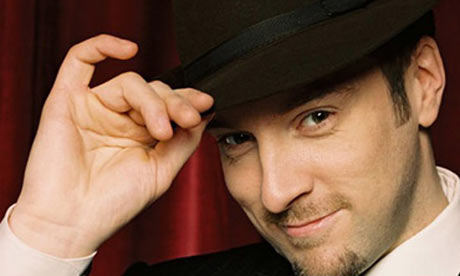
Wow! This was the 4th time I have seen the fabulous Mr Brown live and it was quite simply "The most impressive thing I have ever seen"
Even when you think he has lost control, he's just fucking with you. Even when you think you're asleep he's fucking with you. To summarise, Derren Brown, can fuck with you anytime he pleases. Oo Er.
A great performer, a great magician, a great story teller, a great comedian.
I hate him. I hate him in all the ways that women hate women that are prettier than they are. The only refuge I can take is that he is both taken and gay, although last night Derren, I think you may have "turned" me.
I won't talk about any of the funky tricks he does because some of you will still be going to see this devil-man in action. All I will say is WoW! Even if you have been following this man's career in the way I have for this long, he can STILL surprise you with just how fucking good he is.
I'm not joking, some sort of Devil-God.
The Science Festival in Brighton - Saturday 27th
This was brought to my attention by Marcus Chown on Twitter about a week ago and I had the day off work for once so thought this would be a nice day out. Fantastic day out!
Had to get there for about 9am when it was opening at 10am because it was sold out and they only had about 50 extra tickets. There was a choice of lectures and presentations from two different theatres. We spent most of the day in Theatre two.
The Hero of the Zero - Fame lab Winner Tom Whyntie talks humorously about the Large Hadron Collider. He explains why finding nothing in this very expensive on-going project may turn out to be a very exciting and helpful result after all. This was a very informative and at times, rather funny look at science and the intentions behind this project. The possible outcomes we explained with honesty and genuine appreciation for all perspectives. A great start and I now understand quite a bit more with regards to what they're actually doing!
The Lying Ape - Brian King and Harry Witchel reveal the amount of deceit that surrounds us. These two, very sadistic men spend the first part of the lecture informing us how necessary and crucial lies are to holding our society together. Social lubrication I believe they refer to it as. THEN! They spend the second part of the lecture telling us how to spot a lie. What the hell are they thinking?? Interesting in places but they didn't go into too much depth with the concept which was a little disappointing, was expecting a little more. But still, a very interesting talk.

The Top 10 Bonkers thins about the universe - This was the main reason I came along to the festival. To meet Marcus Chown. Marcus is without a doubt one of my favourite authors. Having read "The universe next door" "The never ending days of being dead" and "We need to talk about Kelvin" I am always blown away with how interesting he can make certain concepts, but mostly, how accessible and easy to understand Marcus makes some of the heavier, more complicated science. Marcus gave his talk and I was able to chat with him for a while afterwards while he signed books. He is a very modest and humble man, far too humble in my opinion! I asked Marcus a few questions about his knowledge of Anthony's work and was surprised he knew so little. I gave him as much of a summary as one can give in a few minutes and we discussed several other things such as consciousness and it's effect on time and quantum variables. I must say It was a real pleasure to meet Marcus and I hope at some point he'll have the time to look at Anthony's work and drop by on the forum.
Science Story - Michael Moesly's BBC2 series, Science Story, gives us a summary of the evolution of scientific theory focusing mainly on Newton and Hooke. A very polished speaker (obviously) and great to listen to. He gave a great analysis of the famous apple falling from a tree story which has been amplified throughout the centuries because of its very reductionist appeal to years of hard work. Our society really is all about instant gratification forever isn't it.
Climbing the tree of Physics - Three young scientists (including Tom from the first talk) discuss how different branches of scientific theory need to come together to explain different things. I was expecting a lot more from this talk, we ducked out early of Michael Mosely's talk to come see this, not sure why. It wasn't bad, but it wasn't as good as it should have been. Had I known about the last talk we were going to we would have ducked out early from this one too.
The Miller's Tale - Ben Miller is interviewed by Steve Mould about abandoning a PHD in quantum electro-dynamics for a career in TV. As well as fronting Armstrong and Miller he writes on science and takes place in science programmes. Ben discussed the struggle to include some science sketches in his shows, the idiocy of Homeopaths and his interest in the future of science. The night before we came here I had a fairly early night. I could have put on 1 out of 200 old videos full of old TV shows I had recorded but by some strange coincidence I put on Paul Merton the series from about 10 years ago. In some of these sketches was of course, Ben Miller. I stayed behind afterwards to chat with him which was a real bonus to finish the day on. He was very impressed that this was pointed out as he said this was his first ever job in t.v. We discussed the brilliance of Paul Merton. I pointed out how wonderful it is when Paul Merton starts any sentence on Have I got news for you with the words "Is it....(this)" or "is it.....(that)" which was appreciated and agreed with. Look out for his new book, if it's named "From infinity to one" I would like a bit of credit, in fact, all of it! I was tempted to ask him for some tips in blending science and stand-up but I didn't want to ruin the moment by becoming "that guy" = A giant man whore.
A fantastic day out for £10!! Shall definitely be going next year.
Thursday, 18 February 2010
Horizon - What makes a genius?
Best of the three episodes I've watched over the last few weeks. I was totally engaged with this last night, from start to finish it was absolutely rich in content and fantastically balanced. It left you feeling optimistic but deluded about what the human brain is capable of.
Part 1 - Maths Genius! Not quite sure about the process this guy used but it wasn't similar to Daniel Tammett! It was actually mathematically worked out.... amazing. He gave a very good explanation of how he does what he does. He says he's not a genius, a genius he associates with creativity, where as what he does is mechanical. He "plays the piano well and there is a difference between a skill and something that is immensely creative." This is similar to Matt Damon's character in Good Will Hunting. He says as far as he can remember he's just always been able to play. It's not so much creating art but more letting art flow through you because you are tuned in, where others aren't.
Part 2 - The experiment that tested the intuitive estimates of which colour has more dots on a screen was rather interesting. This test allows us to predict the mathematical potential of children and rather accurately too. It also indicates certain precognitive skills and ties in nicely with Malcolm Gladwell's work in Blink. Malcolm discusses snap decisions and how they often prove more accurate than thought out ones. The presenter actually stated when the analytical part of his brain fought the intuitive part he started to struggle. Was this because the intuitive was weakening and the analytical role was being forced due to necessity?
Part 3 - Learning gene identified in mice - Seems slightly cruel (probably not in comparison with some experiments they probably do) but necessary I guess.
Part 4 - Chess - Been playing a lot of chess lately, used to play a lot when I was younger. Obviously very good for coaching your brain to think 10 steps ahead in all realms of life. Are some people blessed or is it the wiring of their brain? Very interesting section about a former player that spent 20 years training to be a chess master, he never broke through and became obsessed with the reason why. He became a neural-scientist and researched brain activity and concluded that chess masters are born, not so much created. His final statement seemed a bit jaded but may have been fairly accurate. People can become great, but the status of genius has to have been something they were born with.
Part 5 - Spotting genius. The IQ test about the "termites" was something I read about recently. Can't remember where, may have been in Gladwell's work. This section helped to open the alternative viewpoint that we can mould our brain to fit our environment. We lose parts of out brain that are not used and strengthen neural pathways that are useful to us. Our brain in this way is like ever changing dictionary that will bring out new editions based on the life and times of its existence. We specialise for our environment but of course, there are some environments that because of our genes, we will excel in more.
Part 6 - Mozart/Stevie wonder - Derek is a remarkable piano player that can her a piece of music once or twice and know how to play it, adapt it slightly to his on whim. The superhero notion of other senses strengthening to compensate is something that has quite often been considered a myth. But it's more a case of the brain re-wiring to adapt in making sense of the world. There is another example of a lady later on who can see through sound. Much like the young boy (name forgotten) who could see through making clicking noises with his tongue and using the vibrations. The book I read on this indicated it could be possible to actually see through your skin based on re-wiring of the brain. Our senses are wired in a certain way based on evolution and it is not technically written in stone in terms of how our brain develops. It is versatile and undoubtably the most unique thing about all of us.
Part 7 - Smartening up through electricity and water! - Yeah I was a bit...errr as well! An experiment here to again improve cognitive skills and intuitive response time which helps to create new path ways as quickly as 30 minutes later. After about a day, it will become functioning. Structural alteration after a day!! Amazing.
Part 8 - Brain Plasticity - This section really complimented the book I read about Brain Plasticity about a year or so ago. A lady explains how she can see through technology that encodes sounds from her brain and allows her to produce images based on the re-wiring of her brain. These pathways have been there since we were babies. Evolution dictates a certain path because it is the most successful in survival for the majority.
Part 9 - The greatest minds combine Knowledge with creativity. "Imagination is more important than knowledge" Einstein. A man had a brain hemorrhage and has been painting ever since, literally. He can't stop, his description of this had a very similar feel to the TLE descriptions Tony has mentioned. This section boasts the paradox of Genius. You need to be open to many things to allow creativity to take effect, but closed enough to focus on that one piece of art, whatever form it may take. Dr Mark Lythgoe of university college London gives a very interesting explanation of this. The walls are higher for some people than others and this can cause problems at either end.
I plan to turn my wall into a window, 95% of it all will apparently go right through.. ;)
Best thing I've watched in a while, highly recommend it. Should be available on i Player. Go watch it. Now!
Wednesday, 17 February 2010


Friday, 12 February 2010
Deratany's Tour de force: London calling?
 I trust that my dear friend in London, Martin Huxter, will see the import of this theater news regarding an associate of mine, the illustrious Jay Paul Deratany; Chicago playwright, attorney , politician and human rights advocate.
Martin, this play would be marvelous on the London stage as well, and you with your dark and swarthy looks and acting ability would be perfect for one of the lead roles. Contact London stage friends!! You will be richly rewarded. ; )

Tuesday, 9 February 2010
Dead Of Night (1945) Dir. Cavalcanti/Crichton
I watched this film last night.. WOW! How incredibly ahead of its time in many ways.
The ITALDian theme becomes apparent very quickly as Deja Vu, Precognition, Time dilation and many other ITALDian related concepts are discussed and explored. The style of the film itself is very engaging to watch as it explores many different stories within a story . This style of film-making has influenced many including Woody Allen, parts of this film reminded me of Deconstructing Harry because of the reasons mentioned.
The ventriloquist (Daemon?) story was indeed quite spooky. I think anything involving talking dolls gives people the chills, this may have gone on to influence films such as Child's Play. The conflict between open mindedness and the need for Scientific proof is acted out nicely by very different characters. The Dr being the voice of (scientific) reason, is the last to be convinced by the party of strange stories and experiences.
This film is also extremely funny in places. I think the Mirror story has a moment where the women turns to the man and says "Shall we dress up and spend lots of money?" Not necessarily hysterical but the delivery is perfect! There are also several other very funny moments in this film. I shall definately buy a copy soon and give it a second watch. Even the Golf story has CGI in it! Special effects in 1945?!!!??! Hitler may not even be dead yet and they're using special effects!!!! Incredible!!!!
The film ends or continues it's loop in a similar way to many other ITLADian films such as 12 Monkeys. The precognitions have been correct and his fate is unavoidable. There is a very nice touch at the end where he flips a coin in order to determine if he should go to the house or not, when the coin shows he shouldn't he ignores this and decides to go anyway illustrating an overwhelming force dictating his destiny.
A very impressive film for its time, both from an ITALDian perspective and just from the love of film/story telling.
*ITLAD = Is there life after death by Anthony Peake*
Sunday, 13 December 2009
Me and Orsen Welles... and that Zak Effron guy.

I really enjoyed Richard Linklater's new film "Me and Orson Welles" and It's hardly surprising. From a guy that made Waking Life, Dazed and Confused and the Before Sunrise/sunset combo the challenge of making Zak Effron likable to me hardly seemed a challenge at all.
The scene where Richard and Gretta are discussing her short story was prectically identical to Linklater's scene in Waking Life where his character describes a novel where nothing happens, just real people have real experiences.
With regards to the film itself, Christian McKay is phenomenal in his portrayal of the arrogant and brilliant actor/director. Zak Effron's character has no struggle at all, he walks into a job and dazzles with minimal effort. There is no major arc for his character, he is as deeply rooted in ego as Welles but with less effort. His youth actually personifies his lack of character to the point where his talent becomes a disadvantage, You think he is there as a nice guy to compare the arrogance of Welles, in fact, it could be argued that Richard is there to remind us that nothing in life should be handed to us so easily, well certainly not if we expect it to taste as sweet as it possibly could. In many ways, Effron is perfectly suited for this role. It's a shame his character wasn't given a chance to show real frustration or anger at being misunderstood. He seems perfectly at ease with people accepting him as someone almost on a karmic pay out! Welles however, commands respect through the use of a reputation created and cultivated. Both these characters are at war with themselves and at war with each other.
Experience and genius vs youth and talent.... It's an explosive match up.
Thursday, 26 November 2009
Van Gogh - Life ain't as sweet without the bitter
It's interesting how the unhappiness of somebody's life can be celebrated from an acceptable distance if it brought entertainment and understanding to others. Van Gogh is a perfect example of this. Would we rather he was a happy, well adjusted human being with a comfortable, easy life? Or are we actually happy he suffered the misery he did as we celebrate his genius?

As a society we have no problems extracting the beauty without questioning the source, sometimes a little too lightly. Some obviously appreciate the entire package of Van Gogh's existence but some just appreciate the beauty without seeing the sadness, not that there's anything necessarily wrong with that.
I am fully aware of the importance of suffering throughout the arc of a person's life. Van Gogh experienced higher highs than most but as a result had to deal with the lower lows, many would consider this both a blessing and a curse. The majority of society lives in a mundane medium in which they rarely venture too far in either direction of happiness or sadness. We are all kept in our safe bubbles of content.
Personally I would rather be someone that experiences life to the full, someone who appreciates beauty and misery so much that they experience both bliss and depression in a fluctuating process. Anytime i drift to far into the middle I usually self destruct because feeling misery is still feeling something right? It's the not feeling anything at all that is the curse. Based on this logic, I certainly agree Van Gogh was the lucky one.
Wednesday, 25 November 2009
Assumed Familiarity
Can't we all just get along? No, probably not. Often, we can all assume such a great deal from other people. We assume they are at the same point in life that we are and will automatically understand our point of view, which is shaped by a lifetime of unique and personal experience. I was born in 1981. You may have been born in 1969. What does this mean? It means that you are on a different path to me and will share similar experiences in recent times, but will have approached them from such a different perspective. This seems like such an obvious thing to point out, but it also seems to be society's biggest downfall, that being the lack of ability to empathise with others.
Then there are other times, particularly as we get older we develop a particular type of screening process. This actually helps us recognise that we have nothing in common with certain people and encourages isolation for many people.
Finding the balance between these two approaches will lead to a healthy outlook, if we deviate too far to either side then we'll probably have problems!
Tuesday, 24 November 2009
The problem of choice - Stranger than fiction

Choice is supposed to be a liberating concept, it's supposed to free us from the shackles of a prisoned life where we are forced to follow only one path. But too much choice is cripling. If the person presented with this choice is an over analytical soul, then he will often reject this choice and self destruct. Why make a choice when you can simply drift along in life?
Well, making a choice, even if it takes you down a wrong path is indeed better than making no choice at all. There is a beautiful illustration as to why this is the case in the film "Stranger than fiction." In this film Will Farrell is advised by Dustin Hoffman to stay at home, not to answer the phone, door, post, basically to cut out all communication. By doing this, he can prevent the plot/storyline/HIS LIFE! from progressing in a way that he deems out of his conrol. What happens is a balldozer comes through his window, forcing the social interaction from him regardless.
The message? You can't run and you can't hide from choice. Make decisions before life makes them for you.
(The day I take my own advice will be the day you see a genius emerge! Untill then..)
Monday, 23 November 2009
Sunday, 16 August 2009
Saturday, 15 August 2009
Wednesday, 5 August 2009
Thank You, Martin Huxter


Friday, 3 July 2009


Monday, 29 June 2009
Saturday, 27 June 2009
Farewell to Michael Jackson - The world's brightest star will shine forever.
It's been a strange few days for me. I never thought I'd ever become one of those silly people that get so upset over the death of a celebrity but Michael Jackson was a little bit more than that. Anybody in my general age bracket will recall his music throughout their childhood, he gave his so we could have ours in a way. What's upset me the most are all of the cruel and judgemental things being said upon his death. The man was never proven to have done anything. Even if he eventually is, I still don't subscribe to the levels of hatred that people choose to throw his way even before that day has come, or indeed after. Compassion is something he had and it's something the world needs to learn in order to deal with some of it's biggest problems. One person I know wrote "Paedophiles don't go to heaven" Aside from the fact that I don't believe in heaven and hell for many reasons including very problematic issues of morality and judgement, this is just blind hate. It gives no consideration for his kids that are left behind and that in itself is self-defeating and contradicting, if people really cared about the well being of children so much they wouldn't put so much hatred into the world.
Now this is very strange for me. I do, despite this level of compassion, have a very sick sense of humour. But that's because it's humour, the intention is to devalue meaning, some people actually seriously believe some things that are so simplistic it worries me. I actually cried for about 5 minutes watching some of his videos and this in itself tells me something.
The world is essentially just energy. There is positive and negative energy. Now people will say to me that I didn't know him the same way I will tell them the same thing, but you can just sense watching his videos that this man was a kind and gentle soul. The thing that really broke my heart was something my friend Nathan said: "He died thinking the world hated him" This is possibly one of the most upsetting things I think I've ever heard. To think what may have been going through his mind over the past few years is simply upsetting.
I grew up watching his videos, listening to his music, but the most influential thing of all was his dancing. Michael Jackson taught me how to dance and for that I will always love him. You have to be in the moment to be a dancer, you have to be one with the world and understand rhythm.Michael was rhythm, he made the beat come alive.
Thanks for everything you put out into this world Michael, your star will always shine. They can't hurt you now.
Sunday, 14 June 2009
The Gun Seller - Hugh Laurie
Hugh Laurie, Hugh Laurie, Hugh Laurie...WHY ARE YOU SO MODEST!!??? You are a fucking genius. This is one of the funniest, wittiest and most enjoyable books I've read in a long time probably ever.
"I hit him because he was trying to kill me," I said "I'm like that"
I heard that Laurie didn't even want to put his name to the book and hesitantly agreed after being told that it needed a name to sell it. Mr Laurie, when will you realise your brilliance? His romantic banter between particular characters is not only perceptive but comforting to experience on the page, he really writes some outstanding dialogue. I will more than likely give this another read very soon, just because laughter is every bit as comforting as realising the intelligence of a guy who deserves every single bit of success he's enjoyed...or should I say achieved
The Outsider - Colin Wilson
I finally finshed this book the other day after taking my sweet-ass time to get to grips with its genius. There is a lot of referencing to books I haven't read which made parts of it somewhat tedious. However, the many sections about Nietzsche, Nijinsky, Van Gogh and Lawrence were thoroughly rewarding. Wilson takes us through a fair and balanced exploration of the outsider and all that it entails. Wilson also manages to summarise perfectly what I've been trying to articulate for many years about the effect film can have on an individual and how it is at best temporary:
...anyone can notice the same phenomenon when he comes out of a theatre or concert or cinema, having been completely 'taken out of himself'. No one would expect to pass through an intense emotional experience and not feel 'a different person' afterwards. But in a cinema you only pass out of your own life into other people's; you learn nothing about yourself; hence the change, the mental reflection, wrought by it can only be expected to last for more than a few hours
Wilson goes on from here but his point is extremely valid. The book can be considered somewhat gloomy but it's a very important book dealing with a very harsh reality of man's paralysis.
If salvation means self-knowledge, then it looks as if most men are pre-destinately dammed
Tuesday, 26 May 2009
My First Stand-up performance
I did my first stand up performance last night at The Cavendish Arms in Stockwell, a brilliant place to get your feet wet in the world of comedy. I brought several friends with me and was lucky enough to have someone record it for me. Anyway...
HERE IT IS!!!

HERE IT IS!!!

Friday, 22 May 2009
Pointless popularity contest....but
Please vote for me. Basically, because It's fun to win stuff...Come, make me immortal!
Thursday, 14 May 2009
1st stand-up spot

I shall be attempting stand up on the 25th of this month at the Cavendish Arms in Stockwell. I think I am both excited and confident but I might be lying.
Tuesday, 5 May 2009
Advice for the month

An insult gives you more satisfaction than praise, provided it smacks of jealousy. ~ Jean Baudrillard
Thursday, 30 April 2009
MC Envy - Blinded by the lights.

So I was at work at 2am the other morning doing very little except watching the NBA play offs and my friend Nikhil dropped in with his laptop and recording equipment to record a new track in our meeting room (It's soundproof!) Now 95% of the music he is involved with isn't my kind of thing. I like hip-hop and not so much the garage, drum and base stuff that quite honestly, just isn't my thing.
But this guy is remarkably talented and HE'S SOOOOO YOUNG!!! He's been doing it for years though and has a brilliant, positive and creative outlook on life. If you get a moment, give the guy a listen to, this is a really great track Envy - Blinded by the lights
Friday, 24 April 2009
ITLADian filmmaking?
Well, after seven years procrastinating, The God Game series (six short digital films which I call surrealist documentaries) is finally going to be viewable online, thanks to the assistance of a member of the younger generation! All the films (and the final capstone work, Being the One: Document of a Delusion) will eventually be upload to my youtube channel, here
For a description of the God Game film project, which was actually completed back in 2002, you can visit my blog.
The premise of the film (surprise surprise) is quite ITLADian - it actually began with a dream I had, about being in an acting class and using a megaphone to create an after-death persona, who would comment on one's life from "the other side." This instantly gave me the idea of making a movie - combining documentary format with role-playing, with psychotherapy, in which I would ask players to imagine their deaths and reconcpetualize their lives, as stories, seen from this transpersonal (Daemonic) POV.
An idea ahead of its time? Let's hope so, anyhow, because it's taken seven years for the films to get "released"! But here they are....
Monday, 20 April 2009
The Fragmented Self
Hi Martin & friends
Here's a recent interview I did as part of a Guardian project with the artist Mark Titchner
It covers various subjects, including schizophrenia, the environmental crisis, multiple personality disorder as relating to our moods, the personal self as Frankenstein's monster, Matrix Warrior, Fight Club, the primal self, mythic narratives of moden movies, and other juicy tidbits.
JH
Saturday, 18 April 2009
New Jersey Devils Playoff Game 1 with Kevin Smith and Jennifer Schwalbach Smith


On the same day I saw the fantastic play God of Carnage I was extremely fortunate to be invited to a Hockey game with the Smith's and several other friends from the world of View Askew. We were grateful guests in the VIP box seats enjoying a spectacular view and wonderful company. Although the night was cut slightly short due to their fatigue of travelling from L.A. that morning, I had an extremely good time chatting with Jen and meeting Amy her husband and once again seeing Teejay. I'd like to thank them both for incredibly kind hospitality to me on my travels and a truely amazing evening. The devils won 4-1 and spirits were high on the train as I got the NJ Transit back to the city. Thanks Kev and Jen, was a pleasure meeting you both.
God of Carnage

I was luckily enough to get tickets (not cheap!) to see the fantastic play God of Carnage during my stay in New York and I thought it was incredibly funny, truly an exhausting journey of humour and drama. Starring Jeff Daniels, Hope Davies, James Gandolfini and Marcia Gay Holden, this witty exploration of parental compromise is perhaps the funniest show I've had the pleasure to catch.

Perfectly paced, the pressure and tension build towards some hilarious climaxes, often at the expense of shortly lived pride and dignity. Gandolfini fluctuates brilliantly between rational and incredibly cut-throat honest. Jeff Daniels comedic timing is perfection and he enjoys some of the best interjections as the play progresses. At the beginning, Gandolfini plays the comedic beats to perfection, often waiting a good 10-15 seconds before replying with a simple one-word-retort. Hope Davies who has been fantastic on Six Degrees recently enjoys a humorous character arch. Her character seems to be the most repressed and when she finally unleashes the fury, the stage is brightened up with all sorts of mess. I hadn't seen much of Marcia Gay Holden before but she was remarkably likable. Her character was very raw, it was one that infected the other characters, she refused to compromise her position which fuels the fun and makes for some fantastic match ups. The chemistry between all four characters is outstanding as they take turns unloading on one another. Gender plays a part as the women take on the men, this is a short lived alliance though as it soon becomes a case of everyone for themselves.
Jeff Daniels monologue about the insignificance of anything we do is something I could relate to and I enjoyed it thoroughly. In the tradition of Peter Boyle's speech about "One guy gets sick, another guy gets well..." it points out how all we're doing is killing time before we ourselves are killed, it doesn't really make a bit of difference. Anna Paquin's speech at the end of my favourite film HurlyBurly is very similar.
Worth every penny, go see it if you're in New York. It's at the Jacobs Theatre.
Thank You to Martin Huxter

Thursday, 9 April 2009
My Blueberry Nights

I watched this for a second time the other night and I really, really like this film. It's a very unconventional romantic drama, in the way that it concentrates on the (eventual)couple's time spent apart, rather than their time together. The Cafe owner (Jude Law) that Elizabeth (Norah Jones) becomes close with tells her the story of the big bowl of keys. Customer's that have left their keys behind after having had too much to drink, also left a story for Jude's character to tell. That's really what the film is about. How we're all making impressions on each others lives, we become entangled with others and often we don't even realise how much. It's in this message that the film really appeals to me.
When we're gone, all that's left is the memories we leave behind in other people's lives.
Elizabeth writes to the Cafe owner she became entangled with in the first 15 minutes of the film. She is asked "Why not just pick up a phone?"
She explains that somethings are just better explained on paper. There is a real glimpse into the decline of romance in modern day times due to technology. The greatest romances include travel, separation, longing, suffering, letters and stories being told. With the invention of social networking sites today it's so much easier to stay in touch with people and also to find people who we sadly lose. This is a great and wonderful thing, but I believe it comes at a price of great story telling.
Imagine:
It was the greatest night of my life, we spoke for hours, we laughed and soaked up every minute of each other's company. Then suddenly, we were separated in the crowd and I couldn't find her. I was heartbroken. I made a promise to myself on the way home that one day I would find her. Half an hour later I looked her up on Facebook and found her, I sent her a message and heard back from her immediately. Then I ate some pie.
You see? Not quite as romantic is it!
But back to the film, Norah Jones and Rachel Weisz look EXACTLY THE SAME!! It's sneaky to put them in a scene together, even when they cross paths they can hardly believe it. Elizabeth gets into several adventures on her travels, forever becoming a part of the lives of several other people who are facing their own problems. She arrives back to the cafe a year later, a better perspective on love, life and anything else that matters. The film is a journey and it's an enjoyable journey.
Sunday, 5 April 2009
Anthony Peake - Author of the month.
My friend, the author Anthony Peake has been voted Author of the month on the Official Graham Hancock website. There are fantastic updates every day on there from the world of science and technology.
Please click here and go and show your support or simply soak up the wonderful discussions that are currently taking place there
Please click here and go and show your support or simply soak up the wonderful discussions that are currently taking place there
Sideways

Probably the best film from 2004 and another for my Top Ten which may have run into the teens in a somewhat strange fashion. It's the most generic method ever to simply take two characters that are very different, put them together and watch the hilarity, but this film is so much smarter than that. We've been both of these characters at different moments of our lives and they illustrate the plight and misery of all men, regardless of circumstance.
Miles (Giamatti)is a self destructive writer fresh off of divorce, clinging to the hope that his recently finished novel will sell and therefor make everything else in his life, seem that much better... Or perhaps just a little less shit. Miles is taking his long time friend Jack (Hayden Church) on a Wine tasting get away in the vineyards of Santa Ynez Valley. Jack is an actor with a sexual appetite that refuses to compromise with his impending marriage and all that this commitment entails. Jack is on the hunt for fresh flavour while Miles wishes to recreate moments of comfort and familiarity. We are given a glimpse of their differences early on when Miles stops by to pick up Jack and is asked to sample two different types of Wedding cake. One of them is light, one of them is dark. If pressed to make a decision, Miles chooses the dark, oh, yes he certainly does.
Before they begin their week, Miles takes Jack on a small detour to see his mother on her birthday. After getting annoyed at her constant meddling in his (ex) marital affairs and complimenting his friend ot the point of embarrassment, Miles believes he has received enough crap to justify stealing a healthy amount of money from his mother's underwear draw. The scene is nicely capped off by his mother asking if he needs some money... oops.

Finally arriving in wine country, Miles hesitantly points out Maya (Virginia Madsen)to Jack. She seems very pleased to see Miles and Jack is not surprised by this, he sees the good qualities in Miles and wishes his somewhat negative friend would attempt to do the same. Still before long he has his own agenda, Maya's friend Stephanie (Sandra Oh) who is a single mother with an appreciation for Jack's more care free approach to life.
What follows is a hysterical exploration of sex, deceit, friendship, a naked trip through an ostrich farm, golf course violence, disappointment, heartbreak and a lot of laughs. The running metaphor of wine is climaxed beautifully in a scene between Miles and Maya. Miles tell us the reason why he likes Pinot Noir so much, it has to be coached and encouraged to reach it's full potential, it can't be rushed and much patience is needed to see the beauty it has to offer.

Miles is a painful character to watch. We watch as he reaches several conversational crossroads and can see he has the ability to make the right choice displaying his many positive qualities, but time and time again we are subjected to him running scared into the familiarity and comfort of misery and failure. It would be rather depressing if it wasn't so funny. "Did you drink and dial?" Jack humorously asks after Miles gives us a display of self-pitying at the restaurant. Moments before they went in there Jack anticipates the fuck up and warns him not to ruin the night. It's at this point that Miles barks the quote of the film at his friend.
I am NOT drinking any FUCKING MERLOT!!!
Having read the book and loved it, I can honestly say that this film does more than do the story, characters and everything about it absolute justice. The type of colour the film is shot in is a distinctive one and really adds to the beauty of the Wine country these two characters embark upon. An absolutely classic film that really shouldn't be missed by anyone.
Thursday, 2 April 2009
Agents of Chaos: Alan Moore's Alchemical Worshop, and an Authentic Miracle of a Movie

Warning: the following review is likely to be somewhat “biased”: When I first read Watchmen in my early twenties, it affected me as deeply as any work of fiction ever had—it changed my life. So my responses to the movie—as described below—are going to be more than a little colored by a highly personal connection to the source material.
Watchmen, the movie, directed by Zack Snyder and adapted by David Hayter and Alex Tze, sticks remarkably close to the source material, the ground-breaking graphic novel written by visionary author Alan Moore (whose name isn’t on the film) and illustrated by Dave Gibbons. Moore is a self-confessed magician and uncontested genius of comic books, and his twelve issue, 300+ page superhero epic is a stupendously ambitious work, not merely one of the great accomplishments of comic book writing, but an outstanding work of fiction in any field. (It made Time magazine’s 100 greatest novels—what more do you need to know?!)
When I first heard about the Watchmen movie, I was skeptical—to put it mildly. In fact, I was indifferent. And when I saw the first stills from the movie, I knew, absolutely knew, it was a bust, that they were turning it into something gaudy and noisy and messy and dumb—what Hollywood does best. Beyond all doubt, “the visionary director of 300”—a mind-numbingly vacuous live-action cartoon cum commercial for Spartan warfare—would debase the material by catering to the lowest sensibilities of the mass audience.

This is followed by the lovely, eerie frozen images of the credits, by which flesh and blood becomes comic book image, or vice versa. The credit sequence is inspired: both delightful—enchanting—and wryly amusing, it lets us know that we are in good hands and can settle back to enjoy the most fully satisfying and morally complex superhero enactment in the history of movies. Watchmen is an authentic miracle of a movie—the best of its kind (the philosophical action fantasy) since The Matrix came out ten years ago. (Plot wise, Watchmen is less ingenious than The Matrix, but morally it’s far more sophisticated.)
What’s really astonishing about this movie is that, in under three hours, it manages to capture not only the spirit of the novel but the full, epic breadth of its storyline. I’ve read the comic book at least a dozen times and yet I couldn’t even say which parts the movie misses out (except for the obvious, the parallel story within a story of “Tales of the Black Freighter”). The odds against a big budget Hollywood adaptation of a fiction masterpiece being almost 100% faithful, and at the same time managing to translate it whole into a new medium, are truly phantasmagorical.
Yet therein may be a problem: Watchmen is so completely true to its source that anyone not already enamored of the comic book may be unable to fully grok it. The storyline is straightforward enough, but the peculiar blend of social realism with the pulp roots of comics, and the idiosyncratic, poetic, magical genius of its creator, make Watchmen utterly unlike any superhero movie, or any movie, we've ever seen before. It’s a freak in the best sense of the word: a creature of unfathomable beauty so unique that some people may mistake it for ugliness. It creates its own aesthetic.

What’s perhaps most unusual about the film is its complete moral ambiguity, the way in which it steps entirely outside of the usual mythic paradigm of good and evil, spins off a parallel reality, and weaves its very own mythic narrative. Just as the graphic novel did within the comics field, Watchmen creates a new paradigm for the superhero movie. It’s a paradigm which I highly doubt other filmmakers will be willing, or able, to match, much less develop. There are no heroes in Watchmen, and no villains either. There are rather extraordinary (and extraordinarily flawed) human beings, struggling to make sense of a world in chaos, wrestling with their own complicity in that chaos. These are easily the richest and most affecting characters to ever grace what is ostensibly a fantasy movie. They are not just functions of the plot, as Neo and Morpheus are functions of the plot. As in all great writing, Watchmen’s story develops out of the characters and not vice versa. And these characters are nothing if not ambiguous.

The most dislikeable of the characters, Ozymandias, is driven by a seemingly pathological, philanthropist desire to save the world, and this he succeeds in doing. But we don’t admire him for it—we can’t admire him, because no end could justify these means. He’s an elitist, driven by intellect and a sense of his innate superiority, but devoid of heart. On the other hand, there is much to admire in the murderous vigilante Rorschach—who is all heart. His code of no compromise, his ruthless implacability, his deranged sense of justice, beneath which is a strange tenderness and a deeply wounded soul. Rorschach simply cares too much not to cause mayhem. Like Travis Bickle, his pain, rage and confusion spills out into the world—and he matches it atrocity for atrocity.

Dr. Manhattan, on the other hand, cares little for humanity’s plight: he’s moved beyond that. Was ever a god this chillingly disconnected, a superhero this utterly disaffected? Yet, as Billy Crudup (the only recognizable face in the movie) plays him, Dr. Manhattan is deeply touching. He’s human despite himself, and in his way he’s as lost a soul as the rest of these characters, because he is so utterly, completely alone. As written by Moore, Dr. Manhattan is the first fully believable depiction of a superhuman being—a god—in movies.

On the face of it, the Comedian is the most sheerly unpleasant of the characters: a rapist and child killer, the puppet of the military industrial complex (in a beautiful twist added by the moviemakers, he’s also JFK’s actual assassin). Yet, loathsome as his actions are, he doesn’t ever become hateful to us. None of the characters are defined—or limited— by their actions; they are far too alive for that. Moore’s genius is that he uses the very limited and limiting genre of the superhero comic as an arena—a sort of child’s playground, but also an alchemical workshop—to work through his philosophical themes and develop flesh and blood characters—like forging gold from lead. With Watchmen, he created a kind of feedback loop that expands the story from genre melodrama, into infinity—the realm of archetypes, of true myth. Paradoxically, by turning superhero archetypes into ordinary, believable human beings, ordinary beings are transformed into something extraordinary, something magical, transcendent.

There are other minor flaws: the sex scene to Leonard Cohen’s “Hallelujah” is something we could certainly have done without; perhaps more seriously, the extreme violence seems out of place here, largely gratuitous—it doesn’t add anything and may even detract from the dreamlike quality of the story (though with the Rorschach scenes a degree of savagery is probably intrinsic to the material). And sometimes what works in the graphic novel can seem mannered and contrived on screen (such as Night Owl’s question, “Whatever happened to the American Dream?”). Moore’s dialogue is often self-consciously clever, loaded, and this works better when we can hear it in our heads and give it our own inflexion. Actors can be all at sea with these multi-layered lines. There are also areas, such as Rorschach’s revealing the abyss of his soul to the liberal-minded psychiatrist, that need more time to be developed, that are rushed and hence diminished, and the film would probably have worked better, been less choppy and more textured, if it had been allowed an additional ten or twenty minutes of screen time.
But despite these flaws, the sheer joy and originality of the source material fills every frame. It animates every performance with an exuberance, audacity, and poetry, that is unique to the genre. I haven’t even begun to analyze the schizophrenic subtext of this film—perhaps another day?—but I can honestly say that, in thirty years of movie-going, I have never been so pleasantly surprised by a movie. Watchmen has every imaginable reason to crash and burn. Yet somehow, against impossible odds, it takes flight.

Monday, 30 March 2009
R.I.P. Andy Hallett

Andy Hallett, who starred as Lorne on the TV series Angel, died of heart failure last night at age 33. My thoughts go out to his friends and family.
Knowing.
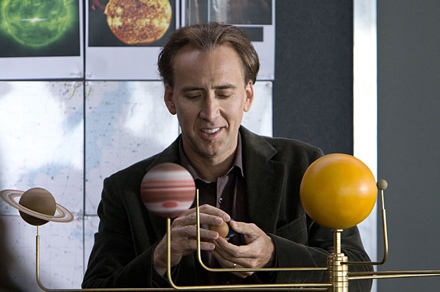
First of all I'd like to say that overall, I was pleasantly surprised with this film. I had heard a lot of bad things and it IS Nicholas Cage on his current run of awful films so, all things considered, it was pretty good. Don't get me wrong, Nicholas Cage is one of my favourite actors, he is capable of some outstanding performances; Bringing out the dead, Leaving Las Vegas, Matchstick Men and Face Off being just several to mention.
The film initially ponders the debate of Determinism vs Probabilistic theory with regards to the origin and fate of the Earth and its hosts, them being us. The factors are obviously hopelessly generic to support the storyline, Nicholas Cage is the son of a preacher who has lost his faith after his wife passed away. He finds comfort in the proceeding events as he learns there was nothing he could do to save her.
The catastrophe scenes with the plane crash and the subway are brutally hard-hitting and loud. Loud in noise, in rawness, they feel incredibly real and this is actually surprisingly scary. The angel people or whatever you want to call them are a freaky cross between James Masters and the "Hush" whisperers from Buffy the Vampire Slayer. The scene where one of them creeps into the boy's bedroom and points behind him out the window to a glimpse of the future is incredibly freaky, mainly because of the music which is rather unsettling.
The gift of death for Emily's daughter brings her the comfort that her mother was not crazy. She doesn't have to endure the pain of letting her daughter leave with the Spike looking Angel people sporting Matrix leather Jackets, unlike Cage's character. Also, It's always a brilliant idea when freaky shit is happening left, right and centre and the world may be ending, to drive to the middle of the forest and leave your children unattended to in the back of a car.
As many critics of Nostradamus have argued, by predicting something we can often make it happen. The ITLADian perspective that we create our own universe can be taken to the extreme view that these predictions become a self-fulfilling prophecy. Nicholas Cage comes into contact with these predictions yet by trying to stop them he merely allows them to follow their natural course. Such reflection is an inevitability, we think we are gaining control over our universe by learning physical laws and understanding it's past but it would seem we are only learning what we are spoon fed. As audience members we have the luxury of looking at the film from an outside perspective and being able to realise certain things that they can't. We are the people in the film and this realisation in itself, is actually rather paradoxical!
So what do we learn from this film? Well, we learn that Bunny Rabbits are regarded to be on a higher hierarchy than Nicholas Cage by Angels. As the kids are taken onto the spaceship they are told they can bring the Bunny Rabbits. The little boy tries to bring his father but soon learns that Nicholas Cage is not a desirable guest for where they're headed. So where are they headed? Well, it seems they are taken to a Weetabix advert to run through the fields. This modern day Adam and Eve run towards a tree which arguably has religious significance. The ending is a bit silly, it's almost as if it abandons its path towards the end and splits into about four different type of genre.
Bunnies yes, Nicholas Cage no.
Saturday, 28 March 2009
Bright Lights Big City

A brilliant film from 1988. So why is this one of my favourites as well? Well, In many ways this film is quite similar to HurlyBurly. It's sort of like HurlyBurly but with an actual storyline! Storyline, how conventionally boring right?
The film is about a young writer who is trying to make a name for himself, despite being trapped in a self-created world of drugs, a terribly mundane job as an editor and a world of pain at the loss of his wife to a career in modeling and his mother to cancer. The film appeals to me in the same way HurlyBurly does in that it celebrates and then condemns self destructive behaviour. Jamie Conway is on a path of destruction and before he can wake up, he must first go down in flames, he must hit rock bottom. His unwillingness to "wake up" on the words of Spike Lee's "School Daze" are shown in a running analogy throughout the film. The newspapers keep us updated on the situation with the "Coma baby" that seems rather stubborn to come out and join the rest of the world.
The film begins with a beautiful shot of Times Square at around 5-6am. Having experienced this view myself after a first date with a New York Girl it brings back wonderful memories. I also lived in the West Village where a lot of this is shot, there are shots of the "Village Cigars" store and the laundrette around the corner from where I lived 17 years after this film was made.
There is one scene with a ferret and Keither Sutherland that almost lowers the tone of the whole film but somehow, they manage to pull it off (literally) without hurting the film too much. The film takes place over the course of a week in the life of Jamie Conway, Sunday is humorously missed out due to a rather large hangover which induces a sleep running into the ever enjoyable Monday morning.
Michael J Fox is very likable and manges to provoke sympathy despite constantly making the wrong choices, he tries to stay in one night and write, however this doesn't last long and he's soon back out sampling some more "Bolivian marching powder" The dialogue is extremely funny in places and allows J. Fox to show off what he does best. His character is a kind of stepping stone from Back to the future to Spin City and he really captures the plight of Jamie Conway. There's something very enjoyable and interesting in living vicariously through others, especially when they're lapping up a life of such a hedonistic nature.
Great film that probably makes my top 10 favourites.
Friday, 27 March 2009
New York City to Welcome Martin Huxter

Living with Demons
Excerpt from The Blood Poets: A Cinema of Savagery, vol. two, "Millennial Blues," by Jake Horsley
If the eye could see the demons that populate the universe, existence would be impossible.
Demons come in all shapes and sizes; they can be metaphor or metaphysic, troll or goblin or gremlin or vampire, werewolf or poltergeist, serial killer or zombie. But, whatever they are, the horror film is a washout without them. Very few movies, horror or otherwise, have endeavoured to deal with demons in the true, theological sense of the word—that is, the inverse of angels, spiritual (therefore invisible) beings that populate the Earth and meddle in the affairs of men, specifically, to possess his body and/or torment his soul. Adrian Lyne’s overwrought but genuinely terrifying thriller, Jacob’s Ladder (1991), is the only, outstanding case I know of of a Hollywood mainstream movie (until Fallen, that is) dealing with “the problem of demons,” more or less directly and (what’s more) intelligently. The fact that, by the end of the movie, the whole story has proven to be no more (but also no less) than the hallucinations of a dying man does little or nothing to detract from the film’s intensity (though it may undermine its integrity somewhat). This is, after all, the story of one man’s soul, and its battle to come to terms with the life it has lived, to overcome the demons of the past that refuse to let it go. Jake’s doctor, played by Danny Aellio, quotes Eckhart on the subject:
The only thing that burns in hell is the part of you that won’t let go... Your memories, your attachments; they burn them all away. They’re not punishing you, they’re freeing your soul. If you’re frightened of dying and you’re holding on, you’ll see devils tearing your life away. But if you’ve made your peace, then the devils are really angels freeing you from the Earth. It’s just a matter of how you look at it, that’s all.
Although as a thriller, Jacob’s Ladder appears to be little more than medieval-gothic/new age hokum, at a more esoteric level, the film is surprisingly, at times disturbingly, persuasive. The writer, Bruce Joel Rubin (who went on to write the insipid Ghost and the loopy Deep Impact ), has obviously taken the time to research his subject, and the film achieves an atmopshere of occult menace and paranoia such as few horror films ever come close to (Polanski’s The Tenant, though a more obviously psychological thriller, is one of the few). Lyne’s direction is characteristically unimaginative, slick and assured but lacking either subtlety or sensitivity. Yet his commerical touch here (Lyne is yet another English filmmaker trained in advertising) is more suited to his material than in his other, uniformly lousy sex-orientated films (Flashdance, 9½ Weeks, Fatal Attraction, Indecent Proposal). He shows a horrifying flare for depictions of demonic presences and hellish landscapes, and the monsters here, which are the monsters of the protagonist’s mind—are amongst the most appalling ever put on the screen.
Lyne’s lack of empathy as a director is compensated for (as it isn’t in his other films) by the presence of Tim Robbins in the lead role of Jake. It’s Robbins’s first major role, and although he doesn’t do anything really suprising here, he’s sympathetic enough in what amounts to a difficult part (like Harry Angel, Jake is the fall-guy), and his proficiency carries the film along. The story concerns not merely demons of the spiritual kind, in fact, but also of the political and technological variety: it’s about a secret mind control drug used on American troops in Vietnam, designed to bring out the savage, aggressive side of the psyche (to tap into the liminal part of the brain?) and to turn the soldiers into “unstoppable killing machines.” The drug proves too effective by half, however, as even the most miniscule doses turn the troops into homicidal maniacs who tear into anything in sight, including each other. What’s worse, a side-effect of the drug is the onset of intense hallucinations, and a kind of sickly, encroaching paranoia. The survivors (of which Jake is one) suffer from the conviction that they are being persecuted by inhuman forces, and literally see demons on every side.
The trouble with the film’s resolution (that Jake is in fact dead) is that, if all this is just a dying man’s dream or vision, then how are we supposed to take it? As a creation of his own mind, or as a projection of a future which he might have lived, had he survived? The film seems to want to have it both ways. After all, we’ve watched the whole movie taking it to be “true,” then, in the last few minutes, we are asked to accept it as a dying man’s fantasy. Obviously, the first hundred minutes far outweigh the last two, no matter how much of a “revelation” they may be. And in actual fact, the last scene is a bust, anyway, because it doesn’t add anything to the film, really, but only takes (or attempts to take) everything we’ve just seen away from us. The film closes with a rather lacklustre caption informing us that, “the hallucinatory drug BZ was used in experimentation on soldiers during the Vietnam war. The Pentagon denied the story.” This—the fact of mind control experimentation by the government—is a reality that I trust most discerning American citizens are aware of by now, however dimly; but the film itself offers us no specifics, no authentic details, no single reason for us to take it as factual. The case it presents us with (even if it hadn’t just been exploded as “fictitious” by the film itself) seems flaky, not because it’s far-fetched or exaggerated (anything but, I fear), but simply because it is insufficiently well-researched, and therefore seems to lack plausibility. Actually, the whole script is a mess, because it seems to be unsure itself, as to whether the demons are an hallucination caused by the army drug, or whether the whole army-drug story is just an hallucination created by the demons, or whether it’s all just a metaphor anyway, created by the human mind, as it prepares to face its annihilation. Etc., etc...
Still, to a large extent, this chaotic lack of structure, of coherent intentions, works for the film and not against it, because it creates an appropriate level of uncertainty and mental panic in the viewer, provided of course that he’s prepared to suspend his disbelief and go along with the action, at a more emotional level; which is where the infernal presences and nightmare visions come in. Jacob’s Ladder is one of the very few recent movies (perhaps the first since The Manchurian Candidate) that successfully describes, or evokes, something of the despair, dread, paranoia and outright horror of modern life, in the age of psychological/germ warfare and shadow governments. It may even be that, with this film, “covert operations” became the modern version of “occult forces,” hence the use of theological terminology here meshes almost seamlessly with the espionage-paranoia plot. Jacob’s Ladder is an outstanding film of the ’80s, because it brings two very distinct kinds of horror together into a single nightmare: the nightmare of control. This effectively combines the ancient fear of possession (i.e., demons) with the modern fear of corruption (i.e., evil men, or government).
Jacob’s Ladder is like an update, for TV generations, of the Frankenstein myth. The hidden forces of the American government, and their Nazi-like doctors (standing in for the old Baron), are never seen in the film—as befits their covert nature—but their presence is certainly felt. No longer working to create life, modern science is now dedicated to conquering the human mind, to turning man into a machine that can be controlled and deployed, like a living weapon. And of course, in the process of harnessing this forbidden knowledge, the demons of the psyche are unleased. Once unleashed, these demons (like Frankenstein’s monster) cannot be placated, they can only be confronted. Knowledge, science, technology, in this myth they all equal disaster. In Lyne’s film, mankind itself, represented by the shadowy, omnipotent but wholly corrupt powers of the Pentagon, has become the modern Prometheus; while society, as the laboratory in which these infernal powers-that-be operate, has become the arena where the unspeakable consequences unfold. It has become Hell on Earth.
Jacob’s Ladder is an authentic apocalyptic vision of a society on the brink of devouring itself, of succumbing to its own insanity, and being overrun by its own demons. Like its protagonist, it walks the razor’s edge between madness and illumination, between paranoia and heightened awareness; and the awful, unthinkable visions it conjurs up are—far from being the deranged rantings of a diseased mind or mere chimera summoned up by blind hysteria—images of things to come. The Vietnam war was a bizarre and covert kind of sociological experiment, as much as it was a bid for power. Drugs were used (on both US and Viet Cong), not only in an insane attempt to win the war, but, more disturbingly, in order to test their properties and discover more about the workings of the human mind, ways in which it might be controlled, manipulated, reshaped, destroyed, and to discover just what the human being was capable of. The war itself was unlike any other war before it or since; none but the very few know what really happened there, or why, and those few aren’t talking.
There’s so such thing as fucking demons!
—Jacob’s Ladder
Subscribe to:
Posts (Atom)


 Posts

